
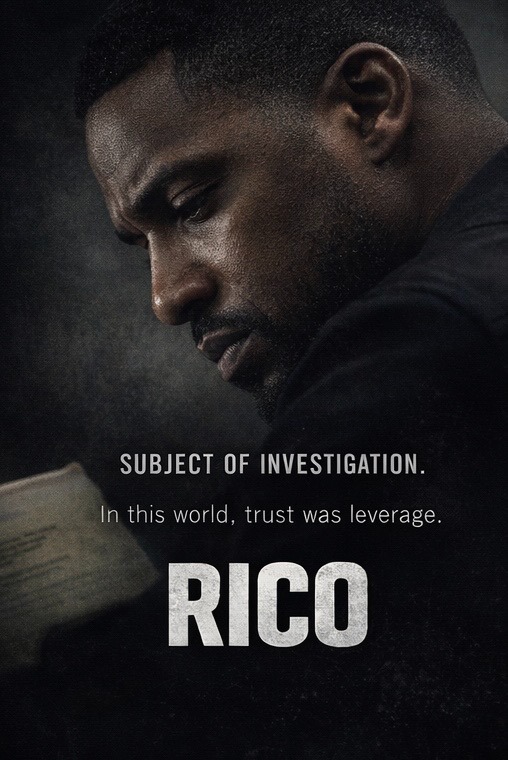
Episode One:
ENTERPRISE "Not Directly"
When a federal indictment redefines who he is overnight, Zaire Quell is forced into a system where perception is power and every word carries consequence. Trust fractures, loyalties shift, and silence becomes an invitation for others to write your story. The first move in a much larger game has already been made.
Zaire Quell sat on the bench in a holding cell with his elbows on his knees, looking at the concrete. There was a crack from the base of the wall to somewhere underneath the bench that he couldn’t see. He’d been looking at that crack for twenty minutes. It was better than looking at the door.
Behind the door was the courtroom.
Behind the courtroom was the rest of his life arranged in counts on an indictment.
He read the indictment. Memorized the counts. The murder count; murder in aid of racketeering, was the toughest to swallow.
He thought about his mother. She’d be in the gallery. He told her not to come but she wouldn’t listen.
She’d be sitting up straight. Third or fourth row. Wearing something dark. She wouldn’t cry in the courtroom. She would save it for later. She always saved it for later.
He thought about Sin, but stopped.
He breathed in through his nose and out his mouth.
He was still Zaire Quell.
Whatever they were about to say he was, he was still that.
The keys turned in the door.
He stood up.
***
They brought him in at 9:14 AM.
The courtroom was already full. Marshals along the walls, reporters with legal pads, family members stiff in the gallery, as if posture could sway the gavel.
Zaire walked through the door wearing restraints.
He was twenty-nine. At fourteen he learned posture was language. Even now, wrists cuffed, marshals flanking, the weight of the Southern District arranged in front of him, he didn’t look at his feet. He looked forward. He found a fixed point and held it.
But that point wasn’t his lawyer, or the judge.
It was the window. Pale light through security glass. The outside reduced to a gray smear.
Sin Carter was already at the defense table.
She wore a navy detention uniform like she chose it. Hair pulled back. No jewelry.
She didn’t look at Rico when they brought him in.
She looked at the prosecutor.
Not at his face. At his hands. At the way he arranged the papers in front of him; deliberate, sequential, the physical grammar of a man who’d done this so many times the preparation had become ritual. He adjusted the microphone without checking it.
She was reading him.
Assistant United States Attorney Omen Kells. Forty-one. Thin in the way of discipline rather than deprivation.
The case was his structure. And Sin learned that structures had architects. Architects had habits. Habits were honest.
She intended to know every one of his before he opened his mouth.
“This is not a street-level narcotics prosecution, Your Honor. The defendants operated as an organized criminal enterprise responsible for trafficking controlled substances, committing acts of violence to protect territory, and laundering proceeds through coordinated financial channels.”
The judge flipped through the superseding complaint. Her expression gave nothing. She had the poise of someone who learned to separate her face from her conclusions.
Omen continued.
“The June 18 shooting was not an isolated dispute. It was an enforcement action.”
Enforcement action.
Two words that drained the blood out of it. Made it policy instead of rage. Policy was easier to prove.
Not Rico shot someone, that was contestable. This was Rico operated a system where shooting was a function.
Which meant the shooting wasn’t the crime.
Being the kind of organization that shoots was.
Sin kept her hands on the table.
Her attorney rose. Allen Rosenstein was fifty-three, silver at the temples. He’d been inside enough federal courtrooms that he stopped being impressed by them. He spoke without notes.
“The government is attempting to convert association into conspiracy. Reputation into racketeering. Ms. Carter is not charged with committing violence. She is charged with knowing people.”
Kane Marr took the stand.
Broad-shouldered. Mid-forties. With the patience of a man trained to read the gaps.
He testified.
Wire intercepts from eighteen months of surveillance. Cash seizures totaling four hundred and twelve thousand dollars across four locations. Messaging applications used to route communications. Cell tower data placing multiple defendants in the same locations on the same dates.
He delivered each item in the same tone.
He listened to these people for a year and a half. Heard them unguarded. Careful. In the moments when they believed the air around them was private.
The air was never private.
Now it was evidence.
Rosenstein approached.
“Agent Marr, did you directly observe my client personally direct an act of violence?”
“No.”
“Personally possess a firearm?”
“No.”
“Personally sell narcotics?”
The pause lasted two seconds.
Agents didn’t pause. A pause meant calculation. Calculation meant doubt.
“Not directly.” Marr replied.
Sin didn’t react. She was trained in the discipline of courtroom stillness. Her hands remained on the table. Her breathing was even.
Not directly.
The judge leaned forward.
“The Court finds that the government has established by clear and convincing evidence that no condition or combination of conditions will reasonably assure the safety of the community.”
Detention ordered.
Gavel.
The case hadn’t been proven.
It had been defined.
And in federal court, definition was the first victory.
***
Two weeks earlier, the case was still small.
In a conference room on the fourth floor of the United States Attorney’s Office, someone taped butcher paper to the wall and wrote names in marker, then drew lines between them.
Omen at the front, sleeves rolled, jacket slung over a chair, running a projector showing phone number chains on the screen. Numbers connected to names. Names connected to cash transfers. Cash transfers dissolved into shell entities registered to addresses that were gas stations and vacant lots.
“The narcotics conspiracy is solid,” he said. “Eighteen months of wire. Three cooperating witnesses at the street level. But it captures maybe forty percent of the coordinated activity.”
David Hass, his supervisor, sat at the head of the table with his hands folded.
“You’re saying this is bigger than drugs.”
“Yep.”
That was the moment the case changed.
Kane Marr remembered that moment. He was standing against the wall with a cup of coffee when he felt the familiar sensation of a case inflating. It could go either way. Inflation meant real pattern, or imagined. Kane had been on cases that went both directions. One of them put a man away for eleven years before a cooperator recanted. Kane was thirty-four then. He attended the exoneration proceeding and said nothing. He’d done his job. The case was still wrong.
He told himself this was the real thing.
He watched Omen draw the arrows on the butcher paper. Omen was a good prosecutor; thorough, precise, not prone to theatrics. Kane trusted his instincts. But he knew instincts, even good ones, needed friction.
Within seventy-two hours, financial analysts had mapped three years of transfers. Four hundred and twelve thousand dollars moved through accounts linked to Rico and a rotating cast of associates. Some funds overlapped with fraudulent small business relief applications filed during the pandemic, loans taken out for businesses that had no employees, no inventory and no verifiable operations.
Separately, everything had an explanation.
Together, it was a pattern.
Coordination began to look like agreement. Agreement began to look like enterprise.
Omen drafted indictment language in his office past midnight. A yellow legal pad covered in crossed-out phrases. He assembled the right words the way you assemble anything load-bearing. Slowly. With attention to what would be tested.
The QV Enterprise was an ongoing organization whose members and associates functioned as a continuing unit for a common purpose of enrichment through criminal activity...
The indictment would allege narcotics distribution across a twenty-nine month window. Murder in aid of racketeering on June 18. Firearms possession in furtherance of drug trafficking, and wire fraud tied to the relief fund applications.
Individually, each charge was survivable.
***
The first person to understand that was Jalen Mercer.
He was twenty-four, had an eighteen month old daughter named Amara, and he’d made three phone calls to a lawyer who didn’t call back before he agreed to sit in a proffer room with the government and talk.
The room was small. There was a table that had been wiped down so many times the surface was faded.
A digital recorder was placed in the center.
Omen sat across from him. Kane sat to the side, slightly back, in the position of someone listening. Mercer’s attorney sat next to him and said twice that his client was here voluntarily.
“We’re not here about one transaction,” Omen said. “We’re not building a case around a single sale or a single transfer. We’re here about the organization itself. How it functioned. Who made decisions.”
Mercer prepared a story. But he hadn’t prepared for the chart Kane slid across the table.
It had lines, names, and arrows indicating flow of communication, money and authority. His name appeared three times. The boxes around the names were different sizes, and he understood size indicated significance.
His box wasn’t large. But it was connected.
He looked at it.
“Help us understand the structure,” Kane said.
Mercer’s attorney went to lean in. Mercer touched his arm. He already did the calculation. He was in the room. He was on the chart. His phone was on the wire. He had signed forms that had a different name than he’d given them.
But what he didn’t know was how much they had. How much of what he said would matter versus confirm.
“Rico didn’t run everything the way people think,” he said. “Dudes made their own moves. It wasn’t like there was a meeting and somebody gave out assignments.”
Omen didn’t argue. “When territory was threatened,” he said, “who made the call about how to respond?”
The light was bright. Somewhere down the hallway a door opened and closed. The recorder sat in the center of the table and waited.
Jalen thought about Amara, and what eighteen months looked like from the outside versus the inside. Time was going to keep doing what time did regardless of what he decided.
“Rico.”
Kane didn’t write. He didn’t need to. He watched Mercer’s attorney look at his client. He recognized the expression. He’d seen it in courtrooms during sentencing, on the faces of people who understood what happened before the person who caused it did.
He had a brief thought about the man he helped put away for eleven years. He thought about what that man’s first cooperating witness looked like in a room like this one.
Then he wrote Mercer’s answer in his notebook and moved on.
Because that was the job.
***
Back in detention, Sin read the superseding indictment three times.
The first time was shock. The second was comprehension, and the third was for strategy.
Member of the QV Enterprise.
Participating in the conduct of enterprise affairs through a pattern of racketeering activity.
Promoting and enhancing the reputation of the Enterprise through public displays and recorded music referencing acts of violence.
Financial interdependence with co-defendants in furtherance of enterprise objectives.
She traced her name on the paper with one finger.
Sin Carter.
Twenty-eight years old. Two albums. With a following that took four years to build. An apartment in her name, car in her name, and a studio she used that the government described in the indictment as a meeting location for enterprise members.
She was a structural component. That’s what they were saying. Not that she’d done something, but she was part of something that did things. Her presence, her output and her money served the architecture.
Allen Rosenstein sat across from her in the attorney room.
Her chair was plastic and bolted to the floor.
Sin ignored it. Comfort wasn’t available.
“Racketeering conspiracy carries twenty years,” Rosenstein said. “If they establish murder in aid of racketeering, the exposure on that count alone becomes substantially greater. They’re also pursuing wire fraud counts aggressively.”
Sin looked at the indictment.
“They don’t have me on drugs.”
“Not directly.”
She recognized the phrase this time like a door she walked through before but now understood it led to somewhere different.
They didn’t need her on tape. They didn’t need her with a gun. They only needed her to have known and stayed.
She sat with that after Rosenstein left.
Twenty years, she thought. She’d been in detention for forty-one days. Forty-one days felt longer than the four years it took to build her following.
Twenty years wasn’t a number. It was a different life.
She thought about what the government was building and how they were building it. Outside in, from intercepts, analysts, chart arrows and a man in a proffer room saying one word into a recorder.
But structures looked different from the inside. The government was describing a shape they inferred. They were working in silhouette.
Whoever spoke from the inside could redraw it.
And drawing lines was its own kind of power.
The next morning, she asked Rosenstein about proffer agreements.
He looked at her.
“You understand what that means for your co-defendants.”
“I understand what twenty years means for me.”
He was quiet.
“It’s not a confession,” he told her.
“I know what it is.”
She signed the next morning. Two pages. Her signature at the bottom with the same hand she used to sign autographs and lease agreements.
***
Across the facility, Zaire was lying on his bunk staring at the ceiling. The mattress was two inches thick and smelled like the previous men who’d slept on it. The ceiling had a water stain in the shape of a state, or a country, or nothing at all.
He calculated the numbers on the drug charges. Still working with the ceiling he’d been given by his lawyer, the one that accounted for the narcotics and firearms and assumed the murder allegation was a reach that wouldn’t survive trial.
Ten years. Maybe twelve if it went bad.
Twelve years was survivable. Twelve years had a shape he could hold in his mind.
But he hadn’t seen the proffer agreement.
The case wasn’t a ceiling.
It was a floor.
The tier was quiet.
A piece of paper slid under the door.
He sat up.
He let it sit there a moment.
Then he stood, took the two steps to reach the door, and picked it up.
When he opened the paper a thin razor fell to the concrete.
Zaire looked at the shiny metal.
Then at the cell door.
Then back at the weapon.
He snatched it up, sat back on his bunk and read the words on the paper.
United States District Court
Southern District of New York
He kept reading.
NOTICE OF INTENT TO INTRODUCE COOPERATING WITNESS TESTIMONY
His eyes moved more carefully now.
The United States hereby provides notice of its intent to introduce testimony from a cooperating witness who is a member and participated in the affairs of the QV Enterprise, including but not limited to conduct charged in the Superseding Indictment.
He read the paragraph twice.
Cooperating witness.
Participated.
Affairs of the QV Enterprise.
He stopped at one word.
Member.
The government anticipates testimony from a member of the QV Enterprise.
Member.
He folded the paper.
For the first time since his arrest, he wasn’t thinking about what he’d done.
He was thinking about who was talking.
-END OF EPISODE ONE-