
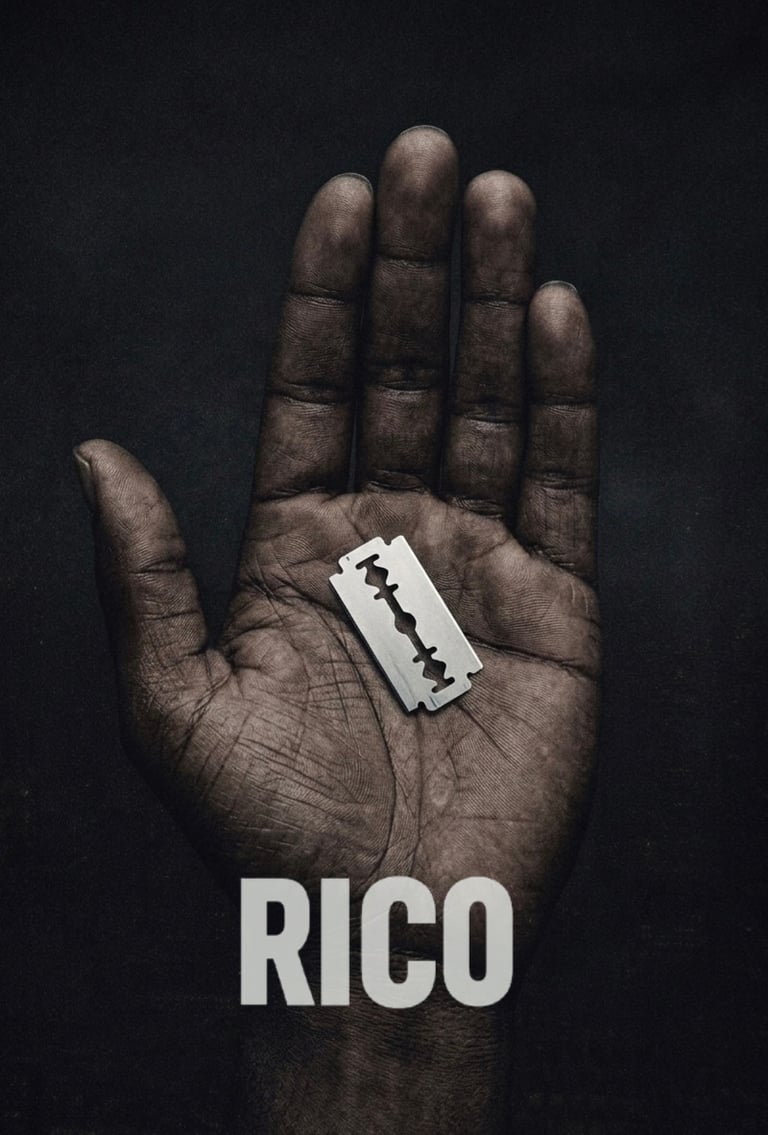

Episode Two:
ZAIRE "Handle it"
Zaire Quell knows what he said. What he doesn't know is what it means, to the government, to the people building a case around two words, and to the one person he trusted who is now in a room describing him.
His new attorney goes backward. The government goes forward. And somewhere in the distance between those directions is the truth about June 18.
Handle it. Two words. Twenty years.
They moved him at 4:37 a.m.
Zaire woke to keys before he opened his eyes.
He sat up slow, already alert. Listening.
“Quell!” the correctional officer barked. “Roll up.”
No questions. Bail review. Seven-thirty. That’s what the CO told him the night before.
He dressed.
Rinsed the razor.
Slid it under his tongue.
Metal against flesh. Quiet. Patient.
The transport van was ice cold. Steel bench. Chain bolted to the floor rail. No real windows. Just a slit in the panel you had to lean into like you were trying to overhear God.
He didn’t bother.
Two men in federal khaki sat across from him. One was asleep, head against the wall, mouth open, breathing heavy. The other one stared at the floor. Waiting. Waiting was a skill. You learned how to suspend yourself between moments. How to stop the clock in your head when the one outside meant nothing.
Zaire closed his eyes.
He didn’t pray. Prayer required patience. He didn’t believe in patience practiced under pressure when it hadn’t been practiced anywhere else.
He calculated instead. That was his ritual.
Narcotics conspiracy. Wire fraud. Firearm enhancement.
Murder in aid of racketeering.
That last one always felt inflated.
The June 18 shooting was real. Too real. He knew what happened that night, knew the names, knew the weight of knowing. But the way they were writing it; enforcement action, authorized response, language that turned a phone call into a policy directive, that was a different kind of real.
That was constructed.
They weren’t prosecuting a shooting.
They were building an enterprise.
***
At the courthouse holding cell, they placed him alone.
He leaned back against the cinderblock wall.
Shifted the razor from the right side of his mouth to the left.
It was freezing. He focused on the cold until he couldn’t feel it, then let his mind move.
Backward first.
He hadn’t intended to be what they were describing.
Nobody begins their story planning to be called an enterprise.
The money started small. Manageable. The kind of small that felt proportional to your size. Then the small became comfortable. Comfortable became expected. Expectation hardened into structure.
Structure carried its own momentum.
Two years ago, it was ten thousand on a good week. Not simple. But bounded. He could see the edges.
By last winter, it pushed into six figures some months. Never movie money. But enough that envelopes felt different in your hand. Heavier. Enough that people started calling instead of texting. The air around him shifted the way pressure shifts before weather.
Territory meant something when there was nothing to protect.
It meant everything once there was.
He didn’t wake up one morning and decide to lead. There was no inauguration. No moment of declaration.
He woke up one morning and realized people were waiting for him to speak.
That was different.
Leadership in his world wasn’t a vote or an appointment. It was gravity. The person money, conflict and decisions circled. He hadn’t campaigned for it. Hadn’t forced it. He was just being consistent. Reliable. Decisive.
Over time, the center drifted. No ceremony. No announcement.
He allowed it.
Sitting in the holding cell, he understood that distinction wouldn’t matter.
The government didn’t prosecute phenomenology, it prosecuted pattern.
Documentation. Repetition.
What happened again and again, not what it felt like the first time.
Allowed and pursued looked the same from the outside.
The door opened.
“Attorney visit.”
He shifted the razor from the left side of his mouth back to the right.
***
Camille Armand entered the room like she’d already been there.
She set her legal pad on the table. Sat down. Looked at Zaire.
Zaire looked at her. “You’re not who I expected.”
“Nobody ever says that in a good way,” she said. “What were you expecting?”
“Someone older. Male. Someone who looked more like—”
“More like what the government looks like?” She opened the legal pad. “Good. That’s the last thing you want across from Omen Kells.”
He studied her. “You know him.”
“I know how he writes indictments. Where he stretches verbs. Where he tightens narratives until they read like facts.” She looked up. “I know because I used to do it. Fifteen years as a federal prosecutor before I decided the other side needed better help than it was getting.”
Zaire was quiet for a moment.
“So you know how this works.”
“I know how this works better than he wants me to.” She uncapped her pen. “Which is why the first thing I’m going to tell you is that your case isn’t about what you did. It’s about what they can make twelve people believe you intended. Those are two different trials and most defendants don’t understand the difference until they’re already losing the second one.”
Zaire leaned back. “And what do you think I intended?”
“I don’t care what you intended,” she said. “I care what you said. Specifically. The words that came out of your mouth on the night of April 14th.”
He looked at her.
“Handle it,” he said.
She let the two words sit on the table between them like evidence. Then she turned the legal pad toward him. On it, she’d written a single word before she came in.
AUTHORIZED.
“That’s their word,” she said. “Not yours. Yours was two words. Theirs is one. You’d think one was smaller than two.” She paused. “You’d be wrong. Their word carries twenty years. Yours carries what you meant, which is only useful if we can prove what you meant, which means I need to know everything that happened before you said it.”
Zaire stared at the word on the pad.
“You saying the call ain’t the case.”
“The call is the exhibit,” Camille said. “The case is the thirty days before the call. The information you were given. The picture of the situation someone painted for you before you responded to it.” She pulled the pad back. “Because handle it is a response. And responses have origins. And the government built their case forward, from your words to the shooting to the indictment. They didn’t build it backward.”
“And backward is where you’re going.”
“Backward is where your defense lives.” She looked at him. “So. Who told you Denton was making a move?”
The room went silent.
He’d been staring at the sixteen words for months. He hadn’t looked at what came before them. Who had brought him the information that made handle it feel like the proportionate response instead of the catastrophic one.
“Someone told you something,” Camille said. “Before you spoke. What did they tell you.”
“They told me Denton was making a move,” he said slowly.
“Was he?”
Zaire looked at the table.
“I believed it,” he said.
Camille underlined what she’d written.
“That distinction is reasonable doubt,” she said, “Who told you?”
He said the name.
Camille wrote it down.
“Is that name in the indictment?” Zaire asked.
“No,” she replied.
“Is it in any case file?”
“Not that I’ve seen.”
Zaire looked at the word AUTHORIZED on the legal pad.
“So he’s out there,” he said.
“For now,” Camille said. She capped her pen. “Here’s what I need you to understand. The government thinks they’ve built a ceiling over you. A fixed number. A cap.” She stood and collected her pad. “They’ve built a floor. And floors crack.” She looked at him one last time. “I find the crack. You don’t talk to anyone, not your co-defendants, not people inside, not anyone who asks questions through third parties, until I tell you it’s time to talk.”
“And when is it time to talk?”
“When talking is a weapon instead of a liability.” She moved to the door. “Right now it’s a liability.”
She knocked for the guard.
“One more thing,” Zaire said.
She turned.
“You didn’t ask if I did it.”
Camille looked at him. “I never ask that,” she said. “What you did is history. What I can prove is the future. I work in the future.”
The door opened.
She was gone before he could respond.
He rolled the razor with his tongue and let it rest against his back molars.
***
Camille came back at 2PM, after the bail hearing.
She sat down, legal pad open, pen uncapped.
“Bail was denied. And Jalen Mercer profferred yesterday,” she said.
Zaire shook his head. “How you know?”
“Because the government amended their detention memo overnight and I read everything they file within an hour of it hitting the docket.” She looked at him. “That’s not a coincidence, that’s Mercer. They added language about decision-making authority. Hierarchical structure. Territory enforcement.”
“He’s tryna save hisself.”
“Of course he is,” Camille said. “That’s not the problem. The problem is what he gave them to work with.” She wrote something on the pad. “Mercer’s a small box on their chart. His value wasn’t facts. It was architecture.”
“And if the shape is wrong?”
“Doesn’t matter if twelve people believe it’s right.” She looked up. “But that’s manageable. Mercer I can work with. Mercer I can cross-examine into the ground because Mercer has exposure and juries understand self-interest.” She paused. “Sin Carter is a different conversation.”
Zaire kept his calm. “What about her.”
“She requested information about proffer agreements. My read? She signed.”
He didn’t say anything.
Camille set her pen down. She needed him to pay attention to what came next.
“I’m going to ask you something and I need you to answer it without deciding first what I can handle.”
Zaire looked at her.
“Is there anything between you and Sin Carter that exists outside the indictment?”
The silence stretched.
“We’re co-defendants,” Zaire said.
Camille looked at him for a long moment.
“That,” she said, “is the most careful non-answer I’ve heard in a room like this.” She wrote something down. “Which tells me everything I need to know and nothing I can use.” She looked up. “So let me put it differently. If Sin Carter sits across from Omen Kells and describes the interior of your operation, is there anything she knows, anything at all, that lives outside the four corners of this indictment?”
Zaire looked at the table.
At the word AUTHORIZED that Camille had written that morning and was still visible as an impression on the legal pad even though she turned the page.
“I don’t know what she knows,” he said.
“But you know what she could know.”
He said nothing.
Camille nodded. She was filing information rather than responding to it.
“Okay,” she said. “Here’s what happens now. Sin Carter talks. She’s precise, she’s going to be precise because that’s who she is. She’ll give them something real. Wrapped in language she controls. The government gets a cooperator with credibility and enough interior knowledge to make the enterprise theory breathe.” She paused. “Which means the case gets harder before it gets easier.”
“So what do we do.”
“We go backward faster than they’re going forward.” She stood. “I need everything about the thirty days before April 14th. Every conversation, every piece of information you received, everyone who told you anything about the situation you were responding to.” She gathered the legal pad. “Starting with the name you gave me this morning. I’m going to find out everything about that name that the government hasn’t found yet.”
“And if what you find doesn’t help?”
Camille looked at him. She considered this possibility and declined to find it useful.
“I don’t go looking for things that don’t help,” she said. “I go looking for the truth. In my experience, the truth and what helps have a way of finding each other when someone’s willing to follow them both far enough back.”
She moved to the door.
“Camille,” he said.
She turned.
“Sin’s not the enemy.”
Camille looked at him. At the specific quality of how he said it, not defensive, not angry. Something quieter. The way you said something about a person when the word enemy was so wrong it almost didn’t deserve a response.
She filed that too.
“In a RICO case,” she said, “the only people who aren’t the enemy are the ones whose interests align with yours.” She looked directly in his eyes. “Right now I don’t know whose interests align with yours. That includes people you trust.” She paused. “Figure out who that is. Carefully. Before someone figures it out for you.”
She knocked for the guard.
Gone.
Zaire sat in the room, alone.
He thought about Sin signing a proffer. About what precise meant when Sin was the one being precise. The specific architecture of her language, the way she built things with words the same way she built everything, with intention, with an eye toward what the structure could bear.
He thought about what she knew.
What she could know.
What she might choose to say.
He didn’t have answers yet.
He had the particular unease of a man who understood that someone he trusted was in a room somewhere making decisions that would shape his life, and that he had no way to know what those decisions looked like from the inside.
He had Camille.
He had a name nobody thought to look for yet.
And he had a crack in a floor they’d built as a ceiling.
For now, that had to be enough.
He ran his palm over his mouth and spit the razor into his hand.
***
Back at the U.S. Attorney’s Office, Omen Kells stood in front of the whiteboard with a marker, adding a line that hadn’t been there the day before.
The names had multiplied. Boxes had grown. The arrows between them had been redrawn in different colors to indicate different types of connection, communication, money, presence, deference.
Kane Marr sat at the table with the summary from Mercer’s proffer open in front of him. He’d read it twice. He was reading it a third time because he was waiting for the feeling that meant he believed them.
“He didn’t give us murder,” Kane said.
“He gave us structure,” Omen replied, still facing the board.
“He gave us his perception of structure.”
Omen turned.
“He placed Quell at the top of territory disputes. Confirmed that financial decisions routed through him in high-level conflicts. Said people deferred.”
Kane looked at the word deferred in the summary. It appeared twice. The analyst who transcribed the session had put it in quotes the first time, which meant Mercer had used it himself rather than being led to it. That mattered. A word volunteered carried different weight than a word suggested.
“Deference implies perception of authority,” Kane said. “Not necessarily actual authority.”
“Perception sustained over time becomes operationally equivalent to authority.”
Kane leaned back. He had heard that argument before. He had made that argument before, in a different case, in front of a different judge. The argument was legally sound. The argument was also, in his experience, a mechanism by which scale could be constructed from constellation, enough distant points connected until they resembled a pattern that may or may not have been there before you started drawing lines.
He thought about the man he helped put away for eleven years. He didn’t allow himself to think about it often. When he did, he tried to be precise about what actually happened, not the exoneration, not the headline, but the granular sequence. The cooperator whose testimony felt credible because it was the cooperator’s genuine perception of events he had interpreted through his own interest. Perception offered as fact. A jury that believed it because it cohered.
Cohesion was not truth. Cohesion was just a story without visible gaps.
“And Carter?” Kane asked.
“She signed.”
That landed differently than Mercer had. Kane had watched Sin in court. Controlled. Architectural in her stillness. Not suppressing reaction, anticipating questions and answering them before they formed, the way certain minds operated in adversarial environments.
“She’s not Mercer,” Kane said.
“I know.”
“Which means if she talks, it’s not going to be panic.”
Omen capped the marker.
“No,” he said. “It’ll be surgical.”
Kane looked at the board. At the arrow pointing from Sin Carter’s box to Zaire Quell’s box, newly drawn, still in a lighter marker, not yet committed.
Be sure this is the real thing.
He moved on. Because that was also the job.
***
Sin sat across from Allen Rosenstein.
“Before we go in,” Rosenstein said, “you understand the parameters.”
“Yes.”
“You speak truthfully. They cannot use your statements directly against you in their case-in-chief if negotiations fail. But derivative evidence is in play. Anything they find because of what you tell them becomes fair game. And if you lie, any part of it, the agreement disappears and you're back to raw exposure.”
“I understand.”
He looked at her.
“Why now, Sin?”
She looked back at him.
“They’re not building cases,” she said. “They’re building narrative. They have their shape. They have Mercer. They have the intercepts and the timeline and the financial maps. Every day I don’t speak, they refine it without me. They’re describing a structure from the outside. The longer I wait, the more that description hardens.”
Rosenstein was quiet.
“This puts you in direct opposition to Quell.”
“I was never in opposition to him,” she said. “But I’m not dying inside someone else’s description.”
Rosenstein held that sentence and nodded.
Then he gathered his documents, and they went in.
***
The proffer room smelled like coffee.
The recorder sat in the center of the table.
Omen sat across from her. Kane sat to the side, slightly back. Listening.
Sin folded her hands on the table.
“You’re alleging an enterprise,” she said, without waiting for a question. “If you want to understand how decisions were made, you need to understand the difference between perception and control.”
Omen leaned forward.
“Walk us through that distinction.”
“People assumed Rico had final say because he was consistent. Not because he held meetings. Not because there was a structure anyone voted on. He was the person who didn’t flinch. That’s what people move toward.”
“So he had final say.”
“He had weight,” she replied. “Gravity. It’s not the same thing as authority.”
“On June 18,” Kane said, “who made the call?”
Sin paused.
The pause lasted long enough that the recorder caught the room breathing.
Inside that pause lived the full complexity of what she was doing, not betrayal as she understood betrayal, not the theatrical kind, not the desperate kind, but something more considered. She was describing a thing that had actually existed in the hope that her description would be more precise than the government’s. That precision was its own form of protection.
“Rico was consulted,” she said.
Consulted.
Not authorized. Not ordered. Not directed.
Consulted.
Omen wrote it down. He understood immediately what she’d done. The word placed Quell at the center without assigning him the active verb. Consultation still established knowledge. Still established involvement. But the architecture of it shifted weight.
He didn’t challenge it. He would let the lawyers parse it later. What mattered now was she was speaking, and speaking was a door, and doors led places.
“Tell me about the money,” he said.
And she told him.
***
When the session ended, Sin walked back to her unit without looking at anyone.
The hallway was painted green from floor to waist and white above that, a color division that had some administrative logic she had never learned and didn’t need to. Her footsteps were flat on the linoleum. Even the sound of movement in here was absorbed, reduced.
She felt lighter and heavier at the same time.
Lighter because she acted. Heavier because action in here always carried the weight of what it meant to someone else.
She hadn’t lied. She chose words carefully, placed them deliberately, declined to offer what was not asked for. She described a thing as it had actually existed rather than the cartoon version the government was drafting.
Whether that was protection or exposure for either of them, she wouldn’t know for months.
What she knew was description was its own kind of power. She had chosen to wield it rather than let it be wielded over her.
***
Across the facility, in a different unit, Zaire lay on his bunk with the superseding indictment open on his chest.
Zaire Quell, also known as Rico.
He hated also known as. It made it sound fictional. Like you were a character someone had invented rather than a person who’d become something gradually.
He read the overt acts section slowly.
June 18: authorized response to encroachment on QV Enterprise territory resulting in the death of Malik Denton.
Authorized.
He stared at the word.
He’d been on the phone that night. That was true. He’d said handle it. That was true. He’d meant pressure, presence, a show of numbers, the kind of force that reminded people where lines were without crossing them irrevocably.
He hadn’t meant Malik Denton’s name in an obituary.
But intent is rarely what survives paperwork. Intent lives in the moment of decision and dies in the space between what you said and what happened. The government didn’t need to prove what he meant. They needed to prove a man died and that his death was connected to a decision that could be traced back to a call he made.
Handle it was three words.
Those three words were now a count of murder in aid of racketeering.
He folded the indictment and slid it under his pillow.
He stared at the ceiling. The water stain was still there. He’d been looking at it every night for six weeks. He decided it was nothing. Just water, finding the path of least resistance, settling into whatever shape the ceiling allowed.
If Sin was talking, the structure was solidifying.
If the structure was solidifying, trial was no longer about what actually happened on any given night. It was about whether the government’s version cohered well enough that twelve people in a box believed it.
Cohesion was easier to prove than chaos.
He understood that now in a way he hadn’t before. He thought the case was about facts; what you did, what you didn’t do, what they could prove. He was beginning to understand that facts were the raw material. What mattered was the story assembled from them, and right now, other people were doing the assembling.
For the first time, he entertained the possibility that survival might require doing something he’d never done.
He rolled onto his side.
Slid the razor from underneath his pillow, and held it.